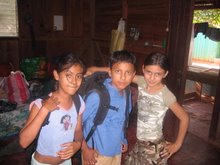
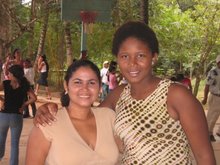
What if?
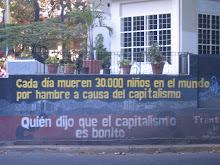
I wonder what would happen if for one month people were only exposed to thoughts of compassion for other people. Informed only on TV about the damage of war and the harm of corporations. If they read books about history that described the real motivations behind our history. If they really listened to the music calling for people to stand up and care about the interests of the world and it´s people.
If people could forget about money for long enough to do this what would it mean to the world. If every person in the rich world had to make a friend in the poor world and listen to the story of their life.
Would there still be 3 billion people in poverty!?
If people were given concrete ways to make a difference to the way the world develops would they chose the yes option or the no if it didn´t cost anything ?
Surely if we believe that we live in democratic countries we are given this option every election. Surely if we live in freedom with technology we can make the decision to understand the other world.
We must acknowledge this opportunity of how we spend our time what we think about and what our consumer and political choices mean to the world!
It is difficult to learn about the world when we are taught to worry about money and image but in freedom we have power.
Exercise the right. Be water on the fire of raging business interests burning the world!
Sunday, 21 January 2007


Wednesday, 17 January 2007
Bogotá
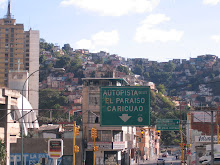
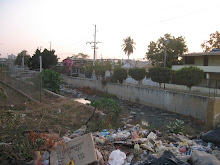
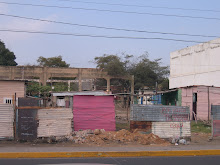
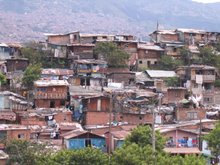
A couple of days ago I took a tour around some of the poorer parts of Bogotà because I told my friend that his city was the most European that I had visited in my trip. True to what he said it was a visit back to the more familiar Latin America with many houses built in the semi-permanent style ¨slum¨style. They first build a square ground floor with a makeshift roof then gradually as resources become available the buildings grow. The areas I saw were actually some of the best low cost housing that I have seen on my trip. The list of sellable traits for real estate agents include: power, 3 storeys high, painted (some), made of brick (as opposed to wood or cardboard) and are built on flat ground unlike those in many cities built on slopes that become death traps with rain. This was in stark contrast to the rural dwellings I saw on my ventures out of the city made of wood with pieces of metal sheeting for roofing.
One of the strangest observations to be made from the areas of sprawl of the city was that there was no police presence at all. In the city centre there are police (who look like military) and military on every corner but in the poorer areas there are none. This either says that the poor don´t commit crime and aren´t the targets of terror attacks or the government doesn´t care about what happens there. Given that some of the outer suburbs were changing hands weekly between urban guerrillas and paramilitary just a few years ago in violent exchanges the latter seems more likely.
The developed appearance of the city perhaps represents the country with highest levels of inequality in all of the countries I have visited. It´s easy to go to a club here and feel like you are in London but then see many people in the streets outside sleeping or begging. The informal economy is also something disturbing about Latin America in general.
Informal economy are people who exist in the city but they really don´t contribute to the economy. They sell gum, cigarettes, snack food, clean shoes, sell newspapers, fresh fruit, advertise by handing out fliers in the street and what they make is what they make. No taxes or permits just the tight margins that they put on products that usually undercut supermarkets. Many people who contribute to the formal economy see these people as an inconvenience pestering them as they get on with there day whether it be working or on vacation. All these people are doing these jobs for survival, whether a part of the formal or informal economy. Most live in the outer suburbs of the city and have come looking for work from the country. One of the most shocking things that really made me wonder about where I was in world was seeing horses dragging carts with people and produce next to new cars through the street of the city. Apparently this will soon be a thing of the past, the plans are to phase out there use over the next year under pressure from animal rights groups and to clean up the image of the city. The question of human rights is the ones that I think need addressing. The right to food, education, health care and security all need to be addressed before the people can be blamed for horse drawn commerce.
There is a lot of debate at the moment about negotiating a free trade agreement with the US which most think will crush these small time vendors by competition. Some would say that this is the way of capitalism. People will chose cheapest prices and the consequences will be what they will be. People who say these things are generally people not selling on the street without any social security or guarantee of income beyond what they have already sold!
The military presence which I often confuse with the police because they both have the same colour uniform and manner is massive with large training centres and bases spread across the city. For some people this is reassuring because it means that guerrillas will have heavy military opposition should they try to come into Bogotá. For many it is a sign of a sick country where everything that exists is maintained by force. I am with the latter. Still after travelling all the way from Mexico seeing machine guns and shotguns daily in the hands of security guards, military and even concerned citizens ( in Oaxaca) I don´t feel comfortable in there presence. A machine who´s purpose is to intimidate as a minimum and exterminate life if those hands decide it´s necessary.
Leaving Bogotá I´m afraid that the image I have of it fits with that of other Capitals I have visited. Great inequality, pollution and insecurity. While I have to say that I enjoyed my time here and could live here were it not for the heavy military presence (or perhaps the need for it) I would not like to do so as one of those living on the outside participating in the informal economy. This can be said for most of the cities I have been to.
A couple of days ago I took a tour around some of the poorer parts of Bogotà because I told my friend that his city was the most European that I had visited in my trip. True to what he said it was a visit back to the more familiar Latin America with many houses built in the semi-permanent style ¨slum¨style. They first build a square ground floor with a makeshift roof then gradually as resources become available the buildings grow. The areas I saw were actually some of the best low cost housing that I have seen on my trip. The list of sellable traits for real estate agents include: power, 3 storeys high, painted (some), made of brick (as opposed to wood or cardboard) and are built on flat ground unlike those in many cities built on slopes that become death traps with rain. This was in stark contrast to the rural dwellings I saw on my ventures out of the city made of wood with pieces of metal sheeting for roofing.
One of the strangest observations to be made from the areas of sprawl of the city was that there was no police presence at all. In the city centre there are police (who look like military) and military on every corner but in the poorer areas there are none. This either says that the poor don´t commit crime and aren´t the targets of terror attacks or the government doesn´t care about what happens there. Given that some of the outer suburbs were changing hands weekly between urban guerrillas and paramilitary just a few years ago in violent exchanges the latter seems more likely.
The developed appearance of the city perhaps represents the country with highest levels of inequality in all of the countries I have visited. It´s easy to go to a club here and feel like you are in London but then see many people in the streets outside sleeping or begging. The informal economy is also something disturbing about Latin America in general.
Informal economy are people who exist in the city but they really don´t contribute to the economy. They sell gum, cigarettes, snack food, clean shoes, sell newspapers, fresh fruit, advertise by handing out fliers in the street and what they make is what they make. No taxes or permits just the tight margins that they put on products that usually undercut supermarkets. Many people who contribute to the formal economy see these people as an inconvenience pestering them as they get on with there day whether it be working or on vacation. All these people are doing these jobs for survival, whether a part of the formal or informal economy. Most live in the outer suburbs of the city and have come looking for work from the country. One of the most shocking things that really made me wonder about where I was in world was seeing horses dragging carts with people and produce next to new cars through the street of the city. Apparently this will soon be a thing of the past, the plans are to phase out there use over the next year under pressure from animal rights groups and to clean up the image of the city. The question of human rights is the ones that I think need addressing. The right to food, education, health care and security all need to be addressed before the people can be blamed for horse drawn commerce.
There is a lot of debate at the moment about negotiating a free trade agreement with the US which most think will crush these small time vendors by competition. Some would say that this is the way of capitalism. People will chose cheapest prices and the consequences will be what they will be. People who say these things are generally people not selling on the street without any social security or guarantee of income beyond what they have already sold!
The military presence which I often confuse with the police because they both have the same colour uniform and manner is massive with large training centres and bases spread across the city. For some people this is reassuring because it means that guerrillas will have heavy military opposition should they try to come into Bogotá. For many it is a sign of a sick country where everything that exists is maintained by force. I am with the latter. Still after travelling all the way from Mexico seeing machine guns and shotguns daily in the hands of security guards, military and even concerned citizens ( in Oaxaca) I don´t feel comfortable in there presence. A machine who´s purpose is to intimidate as a minimum and exterminate life if those hands decide it´s necessary.
Leaving Bogotá I´m afraid that the image I have of it fits with that of other Capitals I have visited. Great inequality, pollution and insecurity. While I have to say that I enjoyed my time here and could live here were it not for the heavy military presence (or perhaps the need for it) I would not like to do so as one of those living on the outside participating in the informal economy. This can be said for most of the cities I have been to.
Sunday, 7 January 2007
Fernando . .can you hear him?

I made a friend the other day walking the streets of Medellin. I had been walking all day and was feeling a little agitated by what I had seen as well as with not really talking to anyone about it when I saw a man in the park. He was sitting under a tree, dirty protecting himself from the wind by some cardboard. He was quite obviously someone who lives in the street. It´s not something I usually do but I was curious to know his story. How did he get to live on the street and how is his life there? So I approached him and said hello.
He was immediately very friendly although difficult to understand because his Spanish was rapid and my ear for it has not yet developed well enough to get as much as I would like from people´s stories, he was soon telling me his life story without me even really asking for it. He had respect for me and asked if it bothered me for him to smoke his crack with me there. He told his friends not to bother me and we chatted away for an hour and a half.
What did I gain from this conversation? He was a nice guy. He has a drug problem but he does not want to cause any harm to anyone else. He wants to get himself into a better life and likes to try to change the image of street people by not robbing polluting and trying to be productive with recycling garbage. He has had problems with his family and become isolated from them which he regrets. The life as a drug addict is not a good one according to him with the threat of violence from security officers and other street dwellers. He sleeps every five days and occasionally ventures out of the city to sleep in peace.
He gave me a small torch lacking a battery as a gift to remember him and we parted ways as friends. I hope some day he gets off the street, until then I hope he remains a good guy willing to spend some time to enlighten the world about his life.
Drugs?

The picture is a graffiti on many walls in Bogota it is a commentary on Bush sending money to spray Coca crops at the expense of many farmers health and livelihood. It's a controversial topic. Each droplet of poison from the plane falls with a $$$ symbol in it. It's all about money! "Adelante presidente!" means something like "Go President!"
I´m in Colombia! Finally I have made it to South America the destination that I was originally inspired to explore. I have 3 months left to see what I can before it´s back to Australia to begin the next chapter.
In Colombia I have been so far to Barranquilla the second biggest city of the country with around 3 million people, Cartagena a beach, colonial tourist town and Medellin another big city 14 hours from Cartagena. So far my impression is that they have greater inequality than those countries I have already visited. There are a small percentage of very rich and a bigger second tier of well off people before a lower class of unemployed and under-employed. The number of under employed is demonstrated by the millions living off selling in the streets. I think these semi-legal enterprises are even more numerous here than Mexico and make up a massive part of the economy. Now they are bringing in a new free trade agreement with the US as most countries of Central America have just signed these businesses are threatened by cheap imports and competition laws favouring multinational sellers. There are many people living in the streets in the three cities men, women and children.
The need for social reform is as clear as anywhere here with only 3% of the population having access to university and 70-80% completing primary school. Education is elite currently there are graffiti protests in Medellin about privatization of the technical college here which threatens to up costs and further limit opportunities. There is however a feel of wealth and prosperity, Christmas lights and advertisements about the new projects of the city and a very clean efficient metro system are symbolic of the people of Medellin. They have an obsession with superficial beauty while leaving the numerous homeless to excrete in the street for lack of free toilets. You can see the slum dwelling "basurera" (garbage people) from the pristine metro service that the people are so proud of. The metro itself excludes all poor people by cost and numerous police at every station. Order is maintained here by massive numbers and active presence of police and army along with a truce among drug traffickers in the city. (Formerly it was the city with the highest murder rate in the world.)
People here voted Uribe back into power recently for a large part on the basis that he aims to exterminate the guerrillas with whom the government has been fighting for the last 40 years with the help of US funding ($billions annually and the greatest recipient of US "aid" outside the middle east). The guerrilla forces begun fighting for social justice for the neglected people of the jungle under a socialist banner. They provided for these people and there own campaigning with drug money. Now most people say the war is just for who gets to export the coke, if the government succeeds in exterminating the rebel forces do you think the supply of drugs to the world will fall? Most experts on the situation don´t consider success of ending cocain availability a posibility. People are tired of the war and enjoy that now they are able to travel within and between cities with less fear of kidnappings or robbery. No doubt this is a good thing. The way it is being achieved is generally accredited to killing off the rebels and forcing them deeper into the jungle. History tells the story that this is not the way to achieve peace both here and abroad (Israel, Ireland etc.)
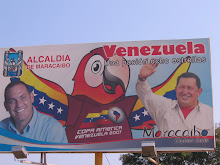
For now it seems that the people in need of a new government are content with the increased security. Uribe got around 60% of the vote with less than 50% participation. The movement of the left which has been going on in the jungle for over 40 years is now distant from the ideals of the poor in the cities. Some are looking to Venezuela with a socialist government making socialist reforms with envy while others think that the US support is Colombia´s way out of trouble and acting against them, as Chavez is doing, is not a way to get out of poverty.
From the hostel scene here and the few elite friends I have made here it seems that for tourists and the rich drugs are readily available and cheap. They seem equally accessible here as in other parts of Latin America I have been although here people are stopped and searched in the street more often making it more dangerous to carry them. There is someone with a machine gun in view constantly walking in the city, either police or private security. They harass the young and the homeless in the interests of security.
I´m looking forward now to a few days out of the cities somewhere on the way to Bogotá before making my way towards Venezuela.
Friday, 29 December 2006
 Mexico
 Arriving in Mexico I could see that roads were very bad, open sewage flowed through the outskirts of the city, people were begging at train stations and in the center of the city, the water from the tap was undrinkable and I was showering from a bucket with water heated on the stove (I asked for them not to heat it but they insisted as part of there hospitality). I saw notices bragging about 20 million people now being supplied power in Mexico City but I was unconvinced of their infrastructure.
Staying with a family in the northern suburbs of Mexico City. Two members of this family were working for multi-nationals (Ford and Siemens) but they didn´t live like the families I had seen that work in their roles. The father of this family has been working for them as an accountant for many years but still they only have one car, old, noisy, rusting (like many in Mexico) and not a Ford. This is a country that is on the edge of first world and 3rd world. Because I knew this I guessed that the people on the street were the ones living in the 3rd world and the ones driving the Mercedes were in the first world. I was also confronted immediately with what I was interested in seeing in Latin America, the life, the people and the politics.
It was immediately after the election results of the Mexican elections had been announced. The candidate campaigning for changes for the poor Obrador was edged out by 0.5% after he had been well ahead in polling until immediately before the election. Obrador was the target of a media attack in the last days before the election by Fox the president at the time. As a result Obrador didn´t, and still hasn´t accepted the result as valid. He took the result to the highest court on the basis of irregularities in counting as well as the use of media by Fox to get the candidate into office. The D.F (District Federal) was overtaken by the protesters in favour of Obrador, there were thousands of banners and signs all over the city as well as flags. People had been camped there for a month at that stage, 4 months later the protest continues.
My perspective entering Mexico was in support of Obrador, the platform of improving services and opportunities for the poor and decreasing corporate corruption I saw as a solid basis for a campaign for what I knew of Mexico. The family that I stayed with and later the rich hostel owners that I spoke to about it weren´t so sure and thought that he may damage the economy. They may well have been right, they are in much closer proximity to the effects of a damaged Mexican economy than I am. Looking for jobs in services is already hard. My friend had been unemployed for 3 months between jobs even though he had a degree and was searching for work each day.
When I went further south I visited Oaxaca where there is an ever escalating conflict between the people and their state government. It started as teachers protests for better wages and conditions in school in line with the standards of the rest of the country. These protests had been taking place almost annually with the government refusing to make changes. I was confronted before arrival by the seriousness of the situation. The roads into the city were closed turning my 8 hr trip bus ride into a 18hr adventure. There were fires lit at every entrance to the city and men with guns guarding the points to prevent the police from entering. This was in response to the killing of 7 people in an attempt to evict the peaceful protesters from the central square of the city. When I arrived there were no police in the city.
Since then the situation has only got worse including the killing of well known US activist Brad Will who was filming at the time of his death. His killers, pro-government paramilitaries sprayed bullets at the protesters killing Brad along with 4 others. People in the south of Mexico remain second class citizens according to all statistical measures. As a result it is likely that the movement of Oaxaca along with the Zapatista movement of Chiapas will continue to grow in significance and resolve to create change. The people have no other option given their living conditions and the obvious inequality that goes beyond neglect. When I left Mexico I was sure that something was going wrong with public spending. There was simply too much money in the country for some people to be living such a high life while others ate in the dirt. This was just the first experience of what it is to travel in Central America . . maybe Latin America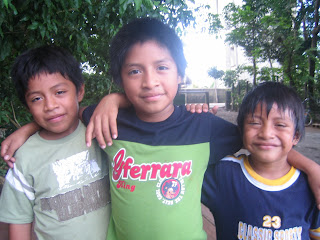

Central America
What do the people want?
- Better transport services!
Safety! - Better pay and working conditions!
- Safe drinking water!
- Garbage collection services!
- Access to education at all levels!
- Freedom to travel to other countries of
- Central America and the world! (both political and financial)
- Foreign business and the rich to contribute towards the development of their country (or leave)!
- Access to land for agriculture and fare prices for goods!
- What are the people like?
- People, they like good times and care for their families. Us people are all just like each other. We have life and love and basic needs.
- Most like American music and movies but know that there own history and current economic status is heavily influenced by US policy.
- They know about what they want and can tell you what they would do if they were president in terms of priorities.
- They believe in hard work religiously and pride themselves on working long hours at tough jobs. It´s not so laid back as the stereotype I came with of people sleeping all day and leaving the work for tomorrow.
- They like Nike, nice watches, new clothes, Coke, TV and cars. I think consumerism has well and truly taken hold here. People don´t want to look dirty or have old clothes and look down on people who do. Men wear long pants and closed shoes as a rule and have there hair done with product every day.
- Attitudes about drinking and drugs are varied. There are many who have the view "drugs are bad" without any knowledge of the difference between marijuana and heroin. Some of these people are heavy beer drinkers or get drunk when they get paid. This is a custom amongst some farm workers which leaves many with a fraction of their weeks work.
Third World? - There are many people living in this part of the world richer than most people I know in Australia. At the same time there are many many more people who don´t eat daily and will not get beyond a year or two of formal education. I don´t like the name third world because it divides us from them. In truth we share this world. Inequality within these countries is really inequality that we all should know. If more people did know it I don´t think it would exist.
Tourists? - Most people are reasonably familiar with tourists. Even in small places that don´t see tourists daily if you ask the people they will tell you that there are a lot of tourist coming through. Maybe it´s because it´s a comparison to the terrible 80´s when war touched the majority of Central America or maybe its because every big backpack is memorable. Local guys are intrigued by the beautiful white women and it´s assumed guys looking for local girls, drugs and beer.
- It´s also assumed in most places that you are from the US (Gringo) and don´t speak Spanish. (Most people in Guatemala have no idea where Australia is, many kids have trouble naming their bordering countries.
- We are associated with money being lost (fairly!).
- From my point of view I think tourists in Central America are much more thoughtful generally and looking for a different kind of experience to most people doing Contiki in Europe.
Government? - The first thing most people will say is that the government has always been corrupt. Many are resigned to that always being the case. Some can detail where the money has gone eg. ownership of companies, distribution of foreign aid etc. others just know that the government says that it´s going to help them and then they don´t.
- The idea of opposition to government is very repressed in everywhere other than Nicaragua where people speak out against the current Sandinista government if they are not for the movement or against the Somoza and US backed governments in the contrasting years.
America - USA
- Most people in Guatemala have a dream of going there. Most I feel have no idea of what it would be like. They don´t speak English and plan to arrive with no money illegally. Men illegally going to the USA with a helper (Cayote) is the main reason why women have the highest death by murder rate in the world. If the man doesn´t pay up his debt his wife is the guarantor!
- Rambo and Rocky, NY City and RNB are what people think about when they think of the US. They know the wages are higher and most have a family member who sent back photos of themselves wearing the latest brands and maybe a gold chain
- Some go and work for a few years save some money and come back although for many I think it´s like a drug that once they go and see the money they have to go back. A lot help out family and extended family with the money they make.
- Many guys get a second wife and family in the US and travel between the two.
- Not many report anything other than a hard life of 12 hr days 6 or 7 days a week as illegals. Some do better but most like to come home to a slower pace of life.
- Some people know about trade deals, foreign ownership as well as crop prices and the role that multi-nationals and US controlled UN bodies (WB and IMF) play in their lives. More than I thought
- There is a Catholic majority in Central America owing to the conquistadors who used the good book as a tool to control the indigenous people.
- Evangelic or Protestant religion is growing under the influence of the 30 million US American´s under this denomination. There is a substantial amount of money and education (or indoctrination) behind this movement. In Guatemala the new church made great gains when the poor people lost faith in the Catholic church for it´s support of the rich and the government in the civil war from 1966-1996.
- I was preached to many times from friends and strangers giving sermons on the bus. The Evangelic church works a lot through creating fear for god, they preach about the end of the world where Evangelic's will survive and all others will be swept from the earth as well as the ability for god to take away food and water from the people if that is what he wants. Some Evangelists say that natural disasters are acts of god striking out against people doing wrong. For Guatemala that must mean that god is very angry at them, they have natural disasters and hunger as daily news. I don´t wish to follow a vengeful god.
Where is the hope for Central America? - I can see the hope in the fact that people know what they want and can tell you about it. They speak with passion about there lives and their countries. These are things which will be vital when the people come together.
- People are calling out for a government that is not going to steal from them and will deliver them the things they need and want. . education, water, power, security, access to land etc. At the moment the people have not moved to the left like the majority of South America although if you ask them what they want the ideas are generally leftist. (as with American and Australian society)
Thursday, 28 December 2006
Explanation for Exploration
August, 2006
This was a message to those I know about what I have been thinking about for the last few years, gradually more and more. I wrote it after time in Germany playing hockey and then travelling in Central Europe on the trip I am currently undertaking around the world. I was feeling angry and impassioned about all that motivated me to leave my path in Australia and meet the people of the world. It was meant to be confronting and demonstrate my real concerns for the world. Here it is ...
Well it was good in Germany, I made lots of new friends, people looked kindly on the Australian friendly. We came 2nd which meant we failed in our bid for promotion for which I was drafted but I played every game and left sure that I contributed what I could. Next to tell you is that I went travelling across Germany and through Czech. Rep, Slovakia, Hungary, Bosnia, Croatia, Slovenia and Poland. Again I met lovely boys and girls along the way and learnt more about these parts of the world and European history than I knew before I went.... but what?
Well I couldn't have been going to tell you about that for years cause it just happened!
First I have a little survey for you like any of you that are on the mailing list of any teenage girls will know but not quite the same anyway here it is please answer it after you have read the rest of the email but you can think about what you will say now.
Do you live in a racist world?
Do you believe your life or that of other people in your is worth more than other peoples?
Do you think that the world is in a good state at the moment?
Do you think it is improving?
Who do you think controls this?
This is not a forward email. It is about the things that I think are important and about why I am travelling around the world instead of being a strength and conditioning coach. It's not easy to tell you all this but I feel it's the best thing for me to do and I want you to know who I really am!
I think the world is heading in the wrong direction. I think that it is being driven their by inhumane forces that are keeping enough people "happy enough" and at least occupied to prevent people really looking at the state of the world. There are a few humans that understand and perpetuate this system but a much larger number who participate without this awareness in perpetuation of our current system. In most developed (rich/exp) countries there are people living below the poverty line. Every city I went to the parks were full of people with no other place to go often covered in cuts and scars smelling of neglect. This neglect haunts me in a world of endless possibilities.
Another guy I spoke to on a park bench in Budapest told me about his battle to keep a family together. To feed his child with special needs, who he loved more than anything as his wife expected but still be at home enough to maintain a relationship. He was losing the battle and considering divorce. The hours demanded of him to run his furniture import business which was barely afloat were too many. The taxes on the imports he pointed at as a major problem along with the taxes on sales and his property. Emerging from the Communist system where education, food and a place to live were guaranteed for those who didn´t make trouble with the government his battle with the adjustment was clear. As it was with the group who sleep in the same park.
Divorce is not just because people don't like each other. Mental health problems, suicides and drug addictions plague the people that are deemed successful by economic data and that lived of the most well off in those places. These are the problems of the successful world. The problems of the rest of the people of the world are food, safe water, disease and education. Opposing these demands in many places are the interests of the rich world in expanding into their countries either to take resources or impregnate society with their culture of consumerism. Many in the rich world think that these problems cannot be solved or they would have been solved already. I don´t agree and those who look at the logistical costs don´t either. The additional estimated cost to bring the poorest people in the world out of poverty is $50 Bil (food, water, education, health care, safe living quarters) less than the ANNUAL oil profits of the top 5 producers and less than half of the cost of the war on Iraq, fought under a false pretext, which it cannot be argued has brought about a better place to live for Iraqi's the death toll and million that have sought asylum and refugee status abroad. I believe the biggest problems of meeting the fundamental needs of all humans is possible. I think the US government and its allies have demonstrated many methods which don´t work.
OK I will start with telling you what I think and then I will tell the long story of how I came to think so those with less time can just battle to the end of part 1.
The world is heading in the wrong direction!
AIDS is killing Africa. If AIDS were killing Americans, decimating the population of Western Europe or even tearing through Japan (and the method of transmission was by being more than a thousand times richer than a million people in the world eg. those that earn more than $365 000 a year) do you think the investment in a vaccine would be greater? Do you think the access to suppressant drugs would exist for all inflicted? Generic drugs which can be manufactured anywhere in the world and sold at a fraction of the cost of patent holding manufacturers are being prevented from reaching the people who need them by the greed (or need for profit) of the drug industry! South Africa was pressured not to bring generic drugs to the country most damaged by AIDS by the US government under the Clinton administration. He is now world ambassador for AIDS! What hope does that leave? If people in Africa were white would they live the same life?
Inequality is growing, AIDS is as much of a problem as ever, countries with developing economies are leaving behind there poor. The example set by the rich forced on the poor by the IMF and WB.
The richest 20% of the worlds people were 30 times richer than the poorest 20% in 1960 now it's 74 times. This is not based on intelligence or worth or anything other than ancestry. It's approximately the richest billion versus the poorest billion.
I may not have told you anything that you don't know yet. Just giving you some context to think about when you answer the survey.
I think the world isn't running the way that it should be. People all over the world are suffering from leadership that doesn't have there best interests at heart. Whether driven by people or markets we need change!
-When you look at policy changes there is a trend away from public health care and welfare. Is this what people want. With debt levels so high because of endless consumerism how many people are going to be able to afford to retire for 30 years after working for 40 years?
-There is war in every corner of the globe reportedly based on religion and many other things but underlying all these conflicts are economic factors whether they are the driving force as in most US interventions or other factors. All through history in tough times people have become fanatical about religion during economic hardship or when they feel injustice is committed against them. It is one way to rationalise atrocity, injustice and inequality.
-The war on terror is threatening to be the armegeddon that some evangelists dream it will be. How can it end? It cannot be won. Do you think Christianity can triumph over Islam?
-Jobs are less secure than they ever. Workplace reforms (as created recently in Australia) tied to trade agreements and aid deals across the worked are making it easier for companies to have "a more fluid workforce." They want the ability to sack people when they want and hire them on the terms that they choose. They want them not to have any collective power or organised voice.
Do these changes sound democratic?
-A poll from the USA showed that US American´s think 20-30% of their budget goes to foreign aid, helping the poor. In fact the US gives the smallest percentage of GDP % of all rich (developed) countries 0.2% well below the 0.7% agreed upon at a world summit on poverty in 2000 where the Millennium Development Goals stipulated many targets to achieve by 2015. This gives me faith in the nature of the US American people but is also appalling to consider the lack of awareness. (Australia is also failing to meet its target with around 0.5% contribution, much smaller than the US in actual terms.)
All these things say that the majority of people are not in control of their countries. Maybe you think that I am going to tell you about some sort of conspiracy of people running the world for there own benefit or that all our leaders are bad and we need to get new ones. I don't think either of these things, maybe someway towards the second but "Bush/Howard hating" is a distraction.
Understanding Power (a book by Noam Chomsky which lays down logic about many things in the world including the concepts below)
Media has a bit influence on the way that people think. Media has gradually become conglomerated, big companies own many different types of media. Media is funded through it's advertisers, (newspapers lose money on the price you pay for them but make money from the advertising they contain, T.V. shows cost money to make and lose through giving away additional money with Game show and Reality TV prizes but make money from advertising and people donating it (SMS)). If media doesn't operate in the interests of business then it doesn't get funding to exist (advertising). Many companies have withdrawn advertising because of critical media which is against consumer spending or business confidence. The same is true for business interests in government, anything overly critical of government can have a big impact on spending and markets. If media rocks the boat then they don't get funded! If any of this sounds impossible please tell me. Which independent media sources do you read? For most the answer is zero, why? ( This is detailed in Understanding Power by Noam Chomsky)
If you want to know about how the influence of the most powerful companies and governments is spread across the world you need to look at the role of the IMF World Bank and loans made to poor countries. Policies in favor of the USA (who most people who know politics will concede run the IMF, WB and to a large extent the UN) are pushed by these bodies and the USA themselves when establish trade and AID deals. When loans made by these bodies, which were tied to often economically harmful conditions, are defaulted on then governments who make the loans have a mechanism to leverage them into making bad deals for trade and resources. (This along with other is detailed in Confessions of an Economic Hit man, a man who created the projects and the need for such massive loans with company pressure and government endorsement)
I think there are a lot of problems! I think there are some answers! This is a part of what I think is the solution.
It was not easy to tell people that this is what I think but I hope you have read it.
I would love to discuss anything you think about this with you. If you have some answers or are doing something already please tell me because I have only relatively recently started to really think about these issues and have a lot more to say and a hundred times more than that to learn!
I have a lot more to do. I know that I am hypocritical of some things that I believe and that there can't be problems with everything except me. At the moment I intend to learn more about the things that I am talking about and turn my beliefs into actions.
Please tell me what you think or answer the survey. I know there is no simple answer. I don't expect to change everything but what is the alternative to trying? Hope I made you think about something.
With love,
Keegan
http://www.census.gov/hhes/www/poverty/histpov/hstpov19.html
This was a message to those I know about what I have been thinking about for the last few years, gradually more and more. I wrote it after time in Germany playing hockey and then travelling in Central Europe on the trip I am currently undertaking around the world. I was feeling angry and impassioned about all that motivated me to leave my path in Australia and meet the people of the world. It was meant to be confronting and demonstrate my real concerns for the world. Here it is ...
Well it was good in Germany, I made lots of new friends, people looked kindly on the Australian friendly. We came 2nd which meant we failed in our bid for promotion for which I was drafted but I played every game and left sure that I contributed what I could. Next to tell you is that I went travelling across Germany and through Czech. Rep, Slovakia, Hungary, Bosnia, Croatia, Slovenia and Poland. Again I met lovely boys and girls along the way and learnt more about these parts of the world and European history than I knew before I went.... but what?
Well I couldn't have been going to tell you about that for years cause it just happened!
First I have a little survey for you like any of you that are on the mailing list of any teenage girls will know but not quite the same anyway here it is please answer it after you have read the rest of the email but you can think about what you will say now.
Do you live in a racist world?
Do you believe your life or that of other people in your is worth more than other peoples?
Do you think that the world is in a good state at the moment?
Do you think it is improving?
Who do you think controls this?
This is not a forward email. It is about the things that I think are important and about why I am travelling around the world instead of being a strength and conditioning coach. It's not easy to tell you all this but I feel it's the best thing for me to do and I want you to know who I really am!
I think the world is heading in the wrong direction. I think that it is being driven their by inhumane forces that are keeping enough people "happy enough" and at least occupied to prevent people really looking at the state of the world. There are a few humans that understand and perpetuate this system but a much larger number who participate without this awareness in perpetuation of our current system. In most developed (rich/exp) countries there are people living below the poverty line. Every city I went to the parks were full of people with no other place to go often covered in cuts and scars smelling of neglect. This neglect haunts me in a world of endless possibilities.
Another guy I spoke to on a park bench in Budapest told me about his battle to keep a family together. To feed his child with special needs, who he loved more than anything as his wife expected but still be at home enough to maintain a relationship. He was losing the battle and considering divorce. The hours demanded of him to run his furniture import business which was barely afloat were too many. The taxes on the imports he pointed at as a major problem along with the taxes on sales and his property. Emerging from the Communist system where education, food and a place to live were guaranteed for those who didn´t make trouble with the government his battle with the adjustment was clear. As it was with the group who sleep in the same park.
Divorce is not just because people don't like each other. Mental health problems, suicides and drug addictions plague the people that are deemed successful by economic data and that lived of the most well off in those places. These are the problems of the successful world. The problems of the rest of the people of the world are food, safe water, disease and education. Opposing these demands in many places are the interests of the rich world in expanding into their countries either to take resources or impregnate society with their culture of consumerism. Many in the rich world think that these problems cannot be solved or they would have been solved already. I don´t agree and those who look at the logistical costs don´t either. The additional estimated cost to bring the poorest people in the world out of poverty is $50 Bil (food, water, education, health care, safe living quarters) less than the ANNUAL oil profits of the top 5 producers and less than half of the cost of the war on Iraq, fought under a false pretext, which it cannot be argued has brought about a better place to live for Iraqi's the death toll and million that have sought asylum and refugee status abroad. I believe the biggest problems of meeting the fundamental needs of all humans is possible. I think the US government and its allies have demonstrated many methods which don´t work.
OK I will start with telling you what I think and then I will tell the long story of how I came to think so those with less time can just battle to the end of part 1.
The world is heading in the wrong direction!
AIDS is killing Africa. If AIDS were killing Americans, decimating the population of Western Europe or even tearing through Japan (and the method of transmission was by being more than a thousand times richer than a million people in the world eg. those that earn more than $365 000 a year) do you think the investment in a vaccine would be greater? Do you think the access to suppressant drugs would exist for all inflicted? Generic drugs which can be manufactured anywhere in the world and sold at a fraction of the cost of patent holding manufacturers are being prevented from reaching the people who need them by the greed (or need for profit) of the drug industry! South Africa was pressured not to bring generic drugs to the country most damaged by AIDS by the US government under the Clinton administration. He is now world ambassador for AIDS! What hope does that leave? If people in Africa were white would they live the same life?
Inequality is growing, AIDS is as much of a problem as ever, countries with developing economies are leaving behind there poor. The example set by the rich forced on the poor by the IMF and WB.
The richest 20% of the worlds people were 30 times richer than the poorest 20% in 1960 now it's 74 times. This is not based on intelligence or worth or anything other than ancestry. It's approximately the richest billion versus the poorest billion.
I may not have told you anything that you don't know yet. Just giving you some context to think about when you answer the survey.
I think the world isn't running the way that it should be. People all over the world are suffering from leadership that doesn't have there best interests at heart. Whether driven by people or markets we need change!
-When you look at policy changes there is a trend away from public health care and welfare. Is this what people want. With debt levels so high because of endless consumerism how many people are going to be able to afford to retire for 30 years after working for 40 years?
-There is war in every corner of the globe reportedly based on religion and many other things but underlying all these conflicts are economic factors whether they are the driving force as in most US interventions or other factors. All through history in tough times people have become fanatical about religion during economic hardship or when they feel injustice is committed against them. It is one way to rationalise atrocity, injustice and inequality.
-The war on terror is threatening to be the armegeddon that some evangelists dream it will be. How can it end? It cannot be won. Do you think Christianity can triumph over Islam?
-Jobs are less secure than they ever. Workplace reforms (as created recently in Australia) tied to trade agreements and aid deals across the worked are making it easier for companies to have "a more fluid workforce." They want the ability to sack people when they want and hire them on the terms that they choose. They want them not to have any collective power or organised voice.
Do these changes sound democratic?
-A poll from the USA showed that US American´s think 20-30% of their budget goes to foreign aid, helping the poor. In fact the US gives the smallest percentage of GDP % of all rich (developed) countries 0.2% well below the 0.7% agreed upon at a world summit on poverty in 2000 where the Millennium Development Goals stipulated many targets to achieve by 2015. This gives me faith in the nature of the US American people but is also appalling to consider the lack of awareness. (Australia is also failing to meet its target with around 0.5% contribution, much smaller than the US in actual terms.)
All these things say that the majority of people are not in control of their countries. Maybe you think that I am going to tell you about some sort of conspiracy of people running the world for there own benefit or that all our leaders are bad and we need to get new ones. I don't think either of these things, maybe someway towards the second but "Bush/Howard hating" is a distraction.
Understanding Power (a book by Noam Chomsky which lays down logic about many things in the world including the concepts below)
Media has a bit influence on the way that people think. Media has gradually become conglomerated, big companies own many different types of media. Media is funded through it's advertisers, (newspapers lose money on the price you pay for them but make money from the advertising they contain, T.V. shows cost money to make and lose through giving away additional money with Game show and Reality TV prizes but make money from advertising and people donating it (SMS)). If media doesn't operate in the interests of business then it doesn't get funding to exist (advertising). Many companies have withdrawn advertising because of critical media which is against consumer spending or business confidence. The same is true for business interests in government, anything overly critical of government can have a big impact on spending and markets. If media rocks the boat then they don't get funded! If any of this sounds impossible please tell me. Which independent media sources do you read? For most the answer is zero, why? ( This is detailed in Understanding Power by Noam Chomsky)
If you want to know about how the influence of the most powerful companies and governments is spread across the world you need to look at the role of the IMF World Bank and loans made to poor countries. Policies in favor of the USA (who most people who know politics will concede run the IMF, WB and to a large extent the UN) are pushed by these bodies and the USA themselves when establish trade and AID deals. When loans made by these bodies, which were tied to often economically harmful conditions, are defaulted on then governments who make the loans have a mechanism to leverage them into making bad deals for trade and resources. (This along with other is detailed in Confessions of an Economic Hit man, a man who created the projects and the need for such massive loans with company pressure and government endorsement)
I think there are a lot of problems! I think there are some answers! This is a part of what I think is the solution.
It was not easy to tell people that this is what I think but I hope you have read it.
I would love to discuss anything you think about this with you. If you have some answers or are doing something already please tell me because I have only relatively recently started to really think about these issues and have a lot more to say and a hundred times more than that to learn!
I have a lot more to do. I know that I am hypocritical of some things that I believe and that there can't be problems with everything except me. At the moment I intend to learn more about the things that I am talking about and turn my beliefs into actions.
Please tell me what you think or answer the survey. I know there is no simple answer. I don't expect to change everything but what is the alternative to trying? Hope I made you think about something.
With love,
Keegan
http://www.census.gov/hhes/www/poverty/histpov/hstpov19.html
Subscribe to:
Posts (Atom)

 Posts
Posts